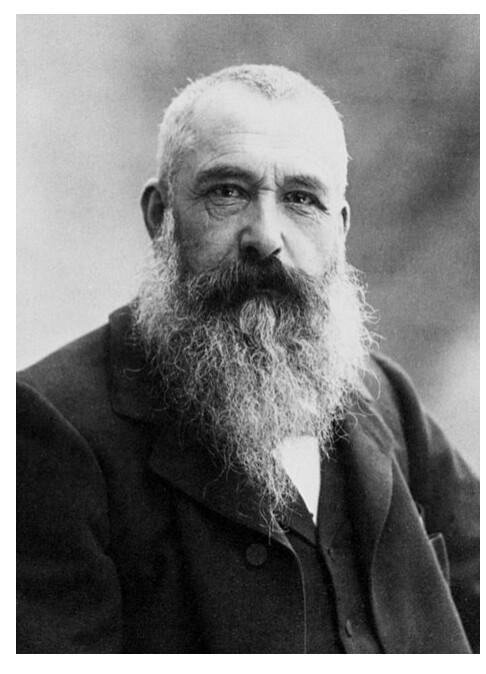
Claude Monet was born in Paris in 1840 and died at Giverny in 1926. Painting out of doors with a small circle of friends in the 1860s and 1870s, he gave Impressionism both its name and its method: to set down the sensation of light as it changes, rather than the fixed look of a thing.
His serial canvases — haystacks, the façade of Rouen Cathedral, mornings on the Seine — returned to one motif until color itself became the subject. In 1883 he settled at Giverny and made the garden, and above all the water-lily pond, the work of his last decades. He set the horizon aside. Leaf, sky, and reflection came to occupy the same surface, and the brushwork grew so free that a close view nearly leaves description behind. Those late paintings became a touchstone for artists after the war who were looking for an abstract landscape.
Monet’s place in the history of modern painting is not a matter of taste. The Water Lilies, in particular, carry Impressionism to its furthest point: a world made entirely of light, still recognizable, and already opening onto the century that followed.
Three private artworks available for acquisition
Serious acquisition inquiries are invited through Presley Fine Arts Inc. All works are offered privately and confidentially.
Confidentiality & Acquisition Requirements
All artworks are represented privately by Presley Fine Arts Inc. To protect the confidentiality of our clients and consignors, qualified prospective purchasers are required to submit a formal Letter of Intent (LOI), satisfactory Proof of Funds (POF), and execute the appropriate Non-Disclosure Agreement (NDA) before any confidential artwork details, provenance documentation, condition reports, pricing, or additional due diligence materials are released. All inquiries are subject to verification and seller approval.